Wednesday, December 20, 1989
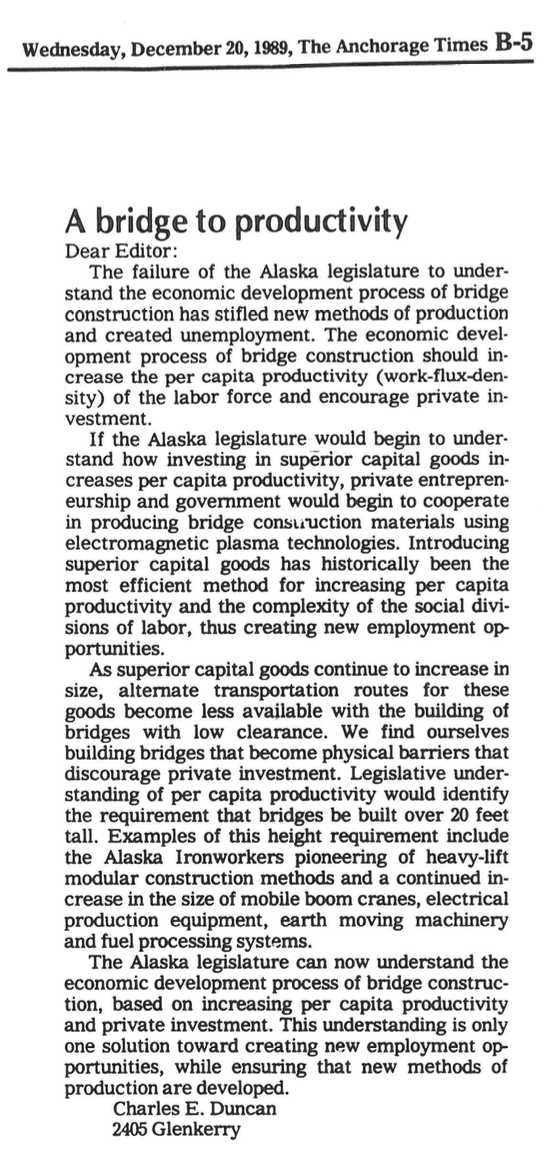
A bridge to productivity.
The failure of the Alaska legislature to understand the economic development process of bridge construction has stifled new methods of production and created unemployment. The economic development process of bridge construction should increase the per capita productivity (work-flux-density) of the labor force and encourage private investment.
If the Alaska legislature would begin to understand how investing in superior capital goods increases per capita productivity, private entrepreneurship and government would begin to cooperate in producing bridge construction materials using electromagnetic plasma technologies. Introducing superior capital goods has historically been the most efficient method for increasing per capita productivity and the complexity of the social divisions of labor, thus creating new employment opportunities.
As superior capital goods continue to increase in size, alternate transportation routes for these goods become less available with the building of bridges with low clearance. We find ourselves building bridges that become physical barriers that discourage private investment. Legislative understanding of per capita productivity would identify the requirement that bridges be built over 20 feet tall. Examples of this height requirement include the Alaska Ironworkers pioneering of heavy-lift modular construction methods and a continued increase in the size of mobile boom cranes, electrical production equipment, earth moving machinery and fuel processing systems.
The Alaska legislature can now understand the economic development process of bridge construction, based on increasing per capita productivity and private investment. This understanding is only one solution toward creating new employment opportunities, while ensuring that new methods of production are developed.
Charles E. Duncan