The United Alaska Campaigner, 39th year edition—January 2023 Alaska State Bank, Part 2, Introduction to accessing federal and Federal Reserve monetary subsidies
“Alexander Hamilton wrote the majority of the Federalist Papers, founded the American System and became the first United States Secretary of the Treasury.”
The human tragedy of state governments failing to fully access the financial mechanisms continuing to be used to bailout Wall Street asset prices will someday be written as a chapter in United States history. State governments continue to lose billions of federal and Federal Reserve monetary policy dollars each year because of inaction in creating the banking institutions necessary to participate in the financial reforms that began in 2008.
The 2008 operational changes in federal and Federal Reserve monetary policy continue today in the form of massive subsidies for capital and reserve requirements for originated loans, interest income on federal securities and reserves, low-interest loans, and the purchase and guarantee of public and private assets and equity.
To fully access these subsidies in a way that benefits all Alaskans, our political leadership must learn the historical economic model that made the United States an agricultural industrial superpower, historical context of the Alaska State Bank legislation, credit creation methods in bank accounting, and credit guidance with an emphasis on technology credit guidance.
Once these lessons are learned, the requirement for creating the Alaska State Bank becomes the responsibility of Alaska’s political leadership. This issue of the United Alaska Campaigner (UAC) will begin teaching these lessons and will be continued in future editions.
Today, a dominate function of major United States banks is based on money managers originating loans for financial instruments that were illegal in the Federal Deposit Insurance Corporation (FDIC) insured banking system between 1936 to 1982. An honest appraisal of these money managers identifies them as leading an economy that is obsessed with predatory gambling, egregious interest rates, rent extraction, and privatization that debt pyramids the private domestic sector of the economy and forces lower living standards on human populations through financial predation, inflation, and a lack of investment into the physical economy.
Many smaller banks and credit unions continue to provide the fiduciary credit assessment and credit creation that benefits the general population, but the major banks led by oligarchic money managers are relentless in their absorption of the good work of local bankers. Once again, the United States banking system is ripe for reform.
Those Alaskans who have seen my 2020 YouTube Principles of Money and Banking Presentation to the Alaska Legislature or have read the United Alaska Campaigner (UAC) transcript of that video (Alaska State Bank Part 1) already know the four historical reform methods (presidential, congressional, state, and institutional) that have been used for financial reforms in United States history and why this author chose the state banking reform method after the Global Financial Crises that began in 2007.
Also in that UAC presentation is the identification of the three historical theories of banking and why two of those theories are false. The true credit creation, and the false credit intermediation and fractional reserve banking theories that are necessary for understanding how to access federal and Federal Reserve monetary subsidies will be defined again later in this article—after establishing the foundation for understanding the dynamics of history leading up to the writing of the Alaska State Bank legislation.
Alaska State Bank legislation in context of recent history
The institutional reforms of 2008 must be considered somewhat functional in addressing that immediate crisis yet were inequitable, unjust, and unstable. The inequity problem with this reform reasserted the injustice instituted with the passing of the 1913 Federal Reserve Act where massive federal monetary subsidies are received by corporate and financial institutions that do not physically benefit the nation. The 2008 institutional reforms continue this injustice through subsidizing financial asset prices in a way that benefits the wealthy, but the physical production, technology, and infrastructure that helps increase living standards for the average person are not included.
Obviously, the instability problem with the 2008 institutional reforms is that the mass of nonperforming liabilities that began destabilizing 2007 was not allowed to self-extinguish, and instead was bailed out and will, once again, lose its ability to maintain payment schedules (primarily in the corporate sector) and will eventually disintegrate into a crisis requiring another reform in the future.
What has not been fully recognized about the 2008 institutional reforms is that they opened a new opportunity for state governments to participate in federal and Federal Reserve monetary policy financial subsidies—but only if they establish public state banks that originate, securitize, leverage, and transact in concert with our federal government and Federal Reserve.
The 2021 passage of the Infrastructure Investment and Jobs Act adds new life to this opportunity through potentially combining this federal funding with the institutional subsidies that can help to make a new national system of public state banks successful over the long term.
But how can Alaska participate in a national system of public state banks when Alaska college professors in collusion with the political representatives of money managers actively prevent honest discussions about money and banking in order to protect a speculative dominance over loan origination? The constraints on conversations in Alaska’s political and educational institutions end up restricting the economic debate in Alaska to personal and corporate taxation, Permanent Fund Dividend confiscation, and budget cuts, while excluding the credit creation loan origination method in banking.
My hope is that beginning new honest discussions about monetary policy will help create the Alaska State Bank as a new state revenue source and establishing that new bank will help solve the inequity problems of the 2008 reforms—and also lay the foundation for reacting to the next inevitable series of financial crises.
But I need help from the Alaska Legislature to continue these conversations at a higher level. Maybe telling my personal political history that has never been told in the UAC will aid in drawing the attention of Alaska legislative leadership.
Charles Duncan’s political history
In 2018, as a research employee of the Alaska Legislature, I worked with state lawyers as the primary legislative assistant for updating the legislation originally written by State Representative Scott Kawasaki to create the Alaska State Bank as a development, infrastructure, and technology bank that acts as a primary dealer and special depository for the United States Treasury and Federal Reserve.
Even with the errors and omissions that are known to this author, this legislation was so compelling that it passed the Alaska State House Labor and Commerce Committee on its first reading.
To better understand why I was chosen to help write and promote the Alaska State Bank legislation, my history as a researcher and political activist in Alaska will be identified.
It has been 39 years since I published in the State of Alaska’s Official Election Pamphlet about Alaska’s relationship with federal monetary policy. Over the decades, I learned some hard lessons in my lifelong struggle to understand and act on my research into international finance and industrial science.
As a union ironworker for 33 years, I worked in many locations in Alaska to help build infrastructure and industries, and during that time I spent 22 years as an associate of a research news agency—EIR News Service Inc.
In 1984 I ran for the Alaska State House and in 1986 ran for the Alaska State Senate. Over the years, as a member of several institute and foundation systems, gave press conferences, presentations, speeches, appeared on television, and organized for economic conferences in Washington, D.C.; Chicago, Illinois; Seattle, Washington; and Manila, Philippines.
As my lifelong never-ending hobby, I published over 50 letters to the editor and Compass articles in Alaska newspapers and continued to publish the United Alaska Campaigner (UAC) since 1984 as an economics newsletter about financial reform, economic development, and industrial science. As a continuing project of the UAC, I authored the 10-part workforce and economic development series, Alaska Emergency Employment Mobilization.
If you have been a State of Alaska legislator and have not received previous issues of the UAC, then directly blame the Legislative Information Office for coming up with new excuses each year as to why the UAC is not allowed to be distributed into the legislative mail system.
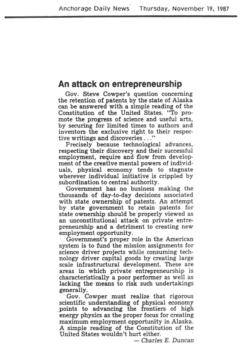
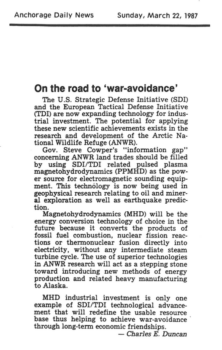
As one of my first campaigns, I wrote a series of articles in this newsletter, and in letters to the editor, and as a candidate for public office promoting the “Star Wars” Strategic Defense Initiative missile defense program. I became the most published author in Alaska on Alaska’s role in participating in the Star Wars program and then became the ironworker construction general foreman for Swanson Steel Erectors during the final phase of building the massive Command and Control Center for missile defense at Fort Greely, Alaska.
Meeting with political leaders to discuss economic development and monetary reform I chaired the Alaska-based limited political party, Independents for Economic Recovery that promoted not only economic development but also AlaskaCare, Medicare, Medicaid, Social Security, Unemployment Insurance, education, childcare, food stamps, and maximum Alaska Permeant Fund dividends.
Working with Chris Tuck, who eventually became a Representative in the Alaska Legislature, we spent over 30 years giving speeches, writing letters to the editor, and passing out copies of the UAC to promote an industrial research institute at the University of Alaska Anchorage that was finally built in 2015. During the dedication ceremony forthe new UAA Engineering & Industry Building, I was escorted off the property by university police for refusing to stop passing out copies of the UAC.
As a continuing student at the University of Alaska Anchorage I was on a decades-long campaign to pass out copies of the UAC on campus. Having campus police called by British System economics professors became a regular event because they called me “disruptive” and accused me of “ruining entire semesters of students” because students had read issues of the UAC. Although, economics professor P.J. Hill, who I had badgered for several months in his money and banking class, eventually helped me distribute the UAC in Juneau during the legislative session—after the Legislative Information Office again acted as an information gatekeeper and denied me access to the legislative mail system.
My collected works have been desktop published and distributed twice over the years under the title, “The American System of Political Economy in Establishing Alaska’s Industrial Science Policy.”
As my extra fun political project, I chaired the Anchorage Pathway Loop Committee for over 30 years to campaign for the creation of a contiguous greenbelt loop around the Municipality of Anchorage. After decades of passing out Anchorage Pathway Loop newsletters at public events and writing letters to the editor, then-Mayor Rick Mystrom invited me as the author of the trail loop policy to the outdoor dedication ceremony for the official establishment of the Anchorage Trail Loop that is now part of the Anchorage Moose Loop.
Many of my written articles and public debates about my ideas are available online. My website is alaskastatebank.net and my Facebook page is Alaska State Bank Advocate.
Soon, it will be 40 years that I have been writing and distributing my newsletters in Alaska with many sacrifices in my personal life to continue this process. As a very friendly and engaging personality freely passing out my newsletters, I have always been shocked and disappointed by the lack of respect many representatives of institutions have for basic democracy in our democratic republic.
My current hope is that maybe someday I will, once again, be given the opportunity to serve the Alaska Legislature in a way that benefits Alaskans. The intention of my political activism has always been to help promote the physical wellbeing and cognitive creativity of all Alaskans and health of our natural world. If you see me standing on a street corner or in the halls of the Alaska Legislature passing out my newsletters, please stop and talk.
I began as a researcher in the early 1980s as a young man working with a team that advocated for President Ronald Reagan to announce what became known as the “Star Wars” Strategic Defense Initiative. In 1984, as part of this team researching military industrial science, I helped develop and publish an industrial science policy for Alaska that would stand the test of time.
The basic Alaska proposal was to use the advancement in high energy flux density military technologies focused on plasma processing that would create new industries in strategic and construction materials, primary reduction of strategic minerals, recycling, and clean fuels—based on establishing a plasma physics research institute at the University of Alaska Anchorage and upgrading and expanding Alaska’s current resource industries.
The problem is that I underestimated the dominance of the British System of political economy’s sustainability doctrine. The unfortunate fact is that this doctrine, taught at the University of Alaska, has been misinforming our political leadership for over 40 years.
I learned firsthand the hard way that the two hidden features of the sustainability doctrine are that all honest money and banking discussions are to be excluded from economic conversations thus restricting all economic debates to fiscal policy. The second hidden feature is that backward non-qualitatively transforming technologies are to be promoted as a controlled opposition to protect the profits deriving from existing productive capacity.
Under this anti-industrial doctrine money managers and banks are not to be challenged to create credit for physical production, and inefficient energy technologies such as wind and solar power production are promoted by advocates with no knowledge of physics in industrial science as technological solutions for environmental problems.
The historical fact is that the political establishment in Alaska continues to restrict economic conversations to fiscal policy while excluding all discussions about monetary policy and advanced industrial technologies. Because of these restrictions and exclusions, many billions of dollars in federal and Federal Reserve monetary policy subsidies have been lost, and Alaska’s existing industries continue to stalemate in their technological advancement.
My hope is that someday the Alaska Legislature will begin honest discussions about both monetary policy and the physics of industrial science and use those discussions as the foundation for establishing the Alaska State Bank as a creator of new state revenue sources.
In the spirit of this hope, I continue this issue of the UAC through summarizing the policies, investigations, and reports of three famous men in the history of banking reform: Alexander Hamilton, Ferdinand Pecora, and Phil Angelides.
Included in the conclusion of this essay is the beginning for understanding criteria for developing a technological credit guidance policy in Alaska based on combining the lessons learned from the investigations of these men with the knowledge of the history and physical principles of industrial science to be used as a feature of a credit guidance policy designed to access federal and Federal Reserve monetary policy subsidies.
Alexander Hamilton’s American System
The founding of the United States economic system begins with the first United States Secretary of the Treasury Alexander Hamilton’s writings, including his reports to Congress on the subjects of public credit, national bank, duties on imports, establishment of a mint, and manufactures.
These reports authored by Hamilton represented a fundamental challenge to the British East India Company’s dominance over the teaching of what became known as macroeconomics and identifies the economic system that was founded to comply with the mandates of the United States Constitution. Even if Adam Smith, John Maynard Keynes, and Karl Marx made caustic statements against the worst abuses of the British East India Company they must be considered in the British System when compared to the policies of Alexander Hamilton.
Using modern terminology, Hamilton says that newly created money should be spent into existence by the federal government; public and private credit should increase the money supply with the help and oversight of a national bank; inflation is controlled through taxation, regulations, and the use of advanced industrial technologies; the federal government should buy state debt; undesirable behavior should be taxed by government; foreign tariffs should protect domestic manufactures and help fund government; the slave trade should be abolished; government should promote the general welfare; federal and state governments have an important role in promoting and funding infrastructure, industry, agriculture, business, entrepreneurship, education, communications, science, and technology.
There have been many updates, improvements, missteps, and back slides over the years since Hamilton founded the United States economic system. Historically, those people who generally agree with Hamilton are considered to be in the American (School) System of political economy and the opposition to Hamilton continues to follow the various competing teachings that derive from the underlying assumptions and educational programs of the British East India Company.
British System propaganda is designed for the employees and subjects of the British Empire to be compliant, ineffective, or confused in challenging imperialistic predatory economic systems. This propaganda currently identifies the two ends of the economic discussion as capitalism versus socialism instead of the true economic dynamic of history as the battle against the genocidal policies and oligarchic educational systems of the British East India Company as an heir to the Roman Empire.
Today, the Wall Street dominated institute and foundation system continues the propaganda of the British East India Company through restricting economic debates to the competing factions of the British System while excluding Alexander Hamilton’s American System from all economic discussions. In the British System, monetary criteria take the priority over physics, physical productivity, and the health and prosperity of human populations.
Alexander Hamilton wrote the majority of the Federalist Papers, founded the American System, and became the first United States Secretary of the Treasury. The sad fact of history is that most educational systems in the United States have succumb to the attempts over the last 230 years to expunge the American System from the teaching of macroeconomics.
The credit creation double-entry accounting method for increasing the money supply in both public and private banking systems has become the super- secret of the financial oligarchy, and the application of physics to demography and industrial science has become the super-secret of the military industrial complex. With very few exceptions, this historical fact is proven with a brief overview of current economic textbooks.
One of the legitimate complaints against Hamilton’s original American System is that he did not clearly identify the predatory speculative processes that directly cause recessions and depressions. This complaint is rectified through the reports of Ferdinand Pecora and Phil Angelides, who provide the investigative foundations for updating the American System through laws and regulations that challenge this never-ending problem in its various changing forms each time it occurs.
Ferdinand Pecora, regulation, and deregulation
After the stock market crash of 1929, Chief Counsel to the United States Senate on Banking and Currency Ferdinand Pecora, identified the causes of the crash that led to the 1930s global depression. Pecora meticulously investigated the predatory asset speculation that had combined with the injustice in international treaty agreements that drove the worldwide depression.
Although no specific legislative recommendations were given through the Pecora investigations, they identified the egregious abuses that established the foundations for lawmakers to pass the Securities Act 1933, Glass-Steagall Act 1933, Tennessee Valley Authority Act 1933, Securities Exchange Act 1934, Works Progress Administration 1935, Commodity Exchange Act 1936, Bretton Woods Agreement 1944, and Marshall Plan 1948.
These legislative efforts and presidential agreements, although imperfect, became the foundation of a “New Deal” American System credit guidance policy that included regulations, credit controls, and credit creation that ushered in a new era in economic development based on having the legal ability to distinguish between speculative and productive financial instruments.
Between 1936 and 1982 the United States had an American System credit guidance policy whereby financial predators were held in check and small and medium-sized enterprises that create the majority of jobs had the ability to access low-interest productive financial credit using the local decision-making process of credit assessment and credit creation administrated through local banks with the help and oversight of state and federal agencies.
With Congress as the sovereign issuer of the currency instructing the Treasury to credit accounts through the Federal Reserve for infrastructure, science, technology, education, etc., American business and industry thrived and created rising living standards for all income groups—and the United States became the world’s most powerful agricultural industrial superpower.
Over the years, Congressional deregulation, Presidential ignorance, and British System institutional policy changes at the Federal Reserve and the Treasury’s Office of the Comptroller of the Currency (OCC) caused the reforms that were generally in effect between 1936 to 1982 to be lost. A few of the features of this process include:
1971—President Nixon ended the Bretton Woods international gold reserve system that had its faults but helped protect nations from currency price speculation and helped guarantee long-term international physical investments.
1981—Federal Reserve Chairman Paul Volcker drove interest rates above 20 percent, thus punishing banks into selling long-term debt, and thus beginning the speculative securitization era based on collateralizing and selling off long-term productive debt obligations.
1982—Provisions of the Bank Holding Company Act 1956, Glass-Steagall Act 1933, and Commodity Exchange Act 1936 began being deregulated by the Office of the Comptroller of the Currency (OCC), Congress, and the Federal Reserve Board.
1987—Congress, Alan Greenspan, the Federal Reserve Board, and the OCC fully reinterpreted credit controls for FDIC insured banks, thus reintroducing the asset price gambling that had directly caused the 1929 stock market crash.
1999—Gramm-Leach-Bliley Act officially ended important regulations of the Glass- Steagall Act, unleashing aggressive real-estate subprime lending based on origination and appraisal fraud, and increasing derivatives such as futures, options, indexes, and swap speculation in FDIC insured banks and shadow banks.
After 1999—the deregulation and the loss of credit guidance guaranteed the next financial crisis that surprisingly did not fully manifest until the 2008 Global Financial Crises.
Phil Angelides and a failed reform
The second most famous financial investigation in United States history was led by Phil Angelides, Chairman of the Financial Crises Inquiry Commission and resulted in the Financial Crises Inquiry Report of January 2011.
One of the most important features of this investigation was the identification o the predatory gambling that had already overwhelmed the banking portfolios of FDIC banks prior to the Gramm-Leach- Bliley Act.
The Angelides report identified the specific types of financial instruments that acted in much the same way as the predatory asset gambling that caused the crash of 1929. New names and new procedures had been added to the old methods of British System speculative predation that always ends up in financial bubbles that lose their ability to make debt service payments.
During the Angelides investigations came the failed 2010 Dodd-Frank Wall Street Reform and Consumer Protection Act that attempted to strengthen capital requirements but never functioned to create new productive loans because of interventions by institutions that were protecting their gambling assets. The result was a massive overly complex legal and regulatory regime that acted to aid in the process of large banks taking over smaller banks that could not afford the labor costs necessary to comply with the legislation.
The lessons of both the Pecora and Angelides investigations is that the central tendency of finance is to gamble, not produce, and therefore regulations and credit controls must be in place to prevent finance from driving populations into poverty. The overall lesson is that the financial market system is horrifically inefficient, even if it has some redeeming value, because it not only demands continued regular subsidies from the Federal Reserve but also requires massive subsidies after asset bubbles pop.
The British System does not bring long- term prosperity to nations, only the American System has proven that ability.
The Pecora and Angelides investigations correct and improve the knowledge of Alexander Hamilton’s reports to Congress. Lawmakers can now use this knowledge to create the public state bank credit guidance and regulatory policies that actively promote the physical investments necessary for long-term human prosperity and the health of our natural world.
One of the keys to implementing such a policy is to learn the three historical theories of banking necessary for accessing federal and Federal Reserve monetary subsidies.
Credit creation, credit intermediation, fractional reserve
In the last hundred years there have been three conflicting theories of banking. Two of these theories are false and are continuing to be taught by intellectually corrupt British System economics professors who confuse and mislead citizens trying to understand accounting systems used in government and private banking.
A bank either state chartered or federally chartered essentially buys, securitizes, originates, leverages, or sells financial instruments.
When a new loan is originated in a bank, a “promissory note” financial instrument is created, and then the bank purchases the security from the person or corporation that is creating the debt instrument. In bank accounting systems, this new loan creates a deposit, credit line, or payment for a purchase. The money for the loan does not come from any other account inside or outside the bank. Newly originated bank loans are an increase in the money supply and this, double-entry, asset/liability accounting method is known as “credit creation.”
When a loan was originated in a nonbank fund between 1936–1982, the loan money came from sources outside the institution and there was no increase in the money supply, this process is known as “credit intermediation.”
Some loans, such as loans from the federal Cares Act of 2020 are considered credit intermediation from the point of view of an individual bank because it is credit creation from the Federal Reserve and Treasury— but the primary function of banks when originating loans is credit creation, not credit intermediation.
Another false understanding of how banks function taught by British System university professors is the “fractional reserve” theory of banking that is best understood as nothing but fake propaganda for several reasons.
The fractional reserve theory says that banks multiply central bank reserve money, but legally banks cannot loan out reserve money to a nonbank making this theory false. Reserve money, also called “high powered money,” is used for federal spending and the payment system to net clear checks between banks and is not used to multiply bank loans.
When a loan is originated, the credit assessment team does not consult the reserve compliance department. After the loans are originated, then the required reserves are purchased from the Federal Reserve or other banks by the reserve compliance officers. Newly originated loans in banks are not restricted by the reserves currently held by the bank, thus making the fractional reserve theory absolutely false.
Now that we understand that the credit creation theory of banking is true and the others are false, this knowledge must be applied to state banking policy that stands ready to increase or decrease total loan volume and direction in the context of other credit creation occurring in the economy.
If the other public and private credit creation in an economy fails to maintain credit for productive purposes or the federal government fails to maintain spending for productive purposes, then state banks must intervene to protect the health and prosperity of populations.
The problem is that deregulation and a loss of credit controls in financial systems in recent years has led to the inflationary rise of speculative “shadow banking” that has allowed nonbank funds to increase money supplies using credit creation while the largest of the FDIC banks began interlacing with the predatory shadow banks and filled the FDIC banking system with futures, options, indexes, swaps, and other derivatives that previously had been banned.
This inflationary problem can be solved through both a federal Wall Street transaction sales tax directed against asset gambling (with a small investor exemption) and through creating a new system of public state banks that can help redirect newly created money back into productive investments.
The genius of this American System policy is that it helps to direct monetary flows away from the predatory inflationary money managers and back into the local decision-making process through public state banks partnering with local banks, credit unions, corporations, municipalities, and government agencies that help to spread and diversify loan risk.
If Alaska is to establish the Alaska State Bank as a simple infrastructure bank that evolves into a primary dealer, special depository, development, and technology bank that sells federal securities and holds tax receipts for the Treasury then credit guidance must be written into the founding legislation.
The lessons learned through Alexander Hamilton, Ferdinand Pecora, and Phil Angelides can provide the general outline for the credit guidance policies of a public state bank accessing federal and Federal Reserve monetary subsidies as a new state revenue source.
Technology credit guidance introduced for the next UAC
But there is another major feature of credit guidance that must be learned. Without a functional understanding based on performance metrics for technological progress, credit guidance can be misdirected into obsolete technologies that do not have the ability to increase the technological divisions of labor that increases total employment.
Ultimately, backward technologies end up failing financially because of the inefficiency of the physical investment in comparison to existing competition.
This is the reason performance metrics for technological progress have already been written into the Alaska State Bank legislation. Credit guidance, grants, and subsidies for technology must be directed toward investments that can quantify their physical efficiency or help in establishing the platform for other physically efficient technologies or industries.
Before defining the two basic types of technology credit guidance policies and how the Alaska State Bank can be successful through using both of these methods, the history of the science of technology, and anti-imperial and anti-corruption credit controls must be discussed to ensure the peaceful and uncorrupted future of the Alaska State Bank as a “community of principle” friend in the Pacific Basin.
The next UAC will address these issues in defiance of oligarchic British System university professors and identify and define the physical performance metrics necessary to create the platform for future higher levels of technology, higher living standards, and better health for our natural world.
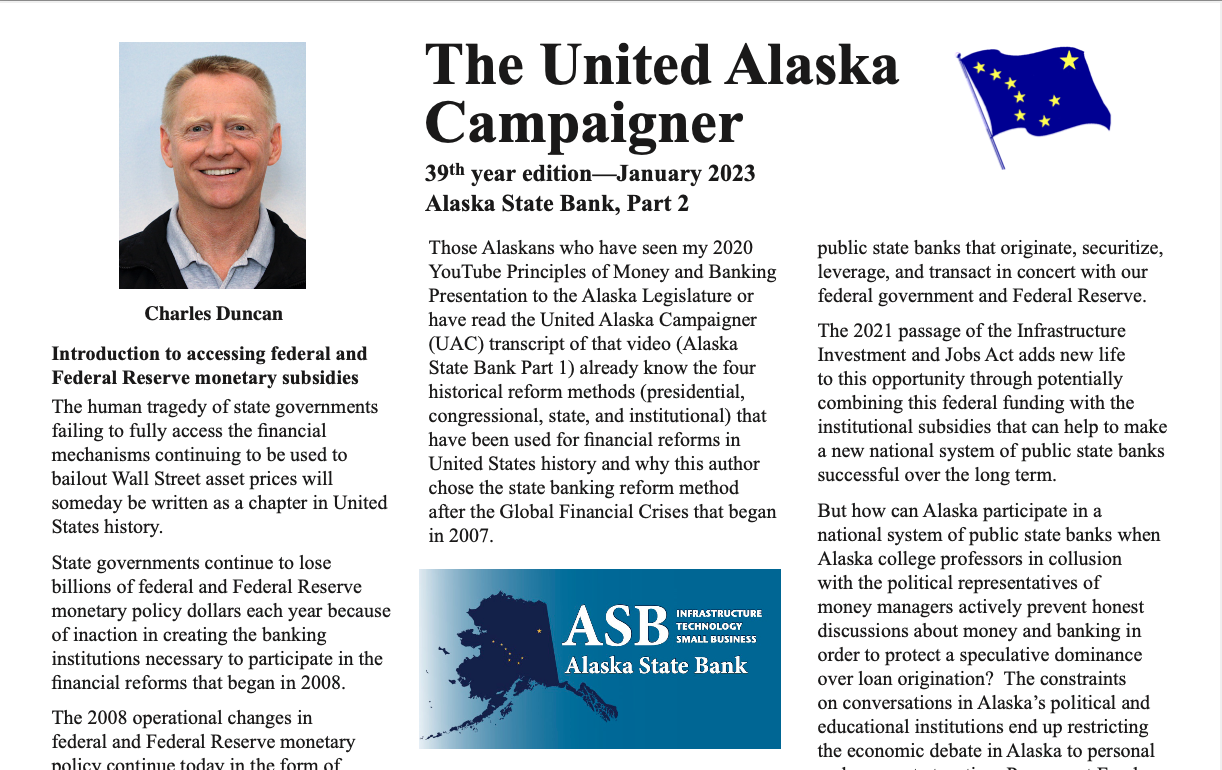
Charles E. Duncan
PO Box 212706
Anchorage Alaska 99521
asced751@yahoo.com
Alaska State Bank Advocate Facebook