THINK BRICS version of my UAC 2025
The following probably AI human assisted version of my Alaska State Bank Part 4 essay is short at about 1,200 words.
The Part 4 version that I wrote is over five thousand words. The original research paper that took me over four months of hard work came in at over seven thousand words. Hopefully, different readers will appreciate different versions and not too much was lost or misunderstood with all the cutting and paraphrasing.
Notice the error in understanding the fourth method of increasing the sovereign unit of account money supply in this AI version.
Think BRICS Jan 14, 2026
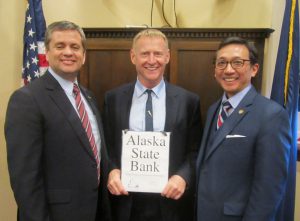
We were contacted by Charles E. Duncan, the primary author of the legislation to create the Alaska State Bank as a development bank. He shared with us his research—also available on the official Alaska State Bank project website—noting several compelling points of alignment between his proposal and the broader goals of the BRICS initiative. We found his analysis thoughtful and timely, especially in how it connects local financial reform with emerging global economic shifts. Because we believe these ideas deserve wider discussion, we’re sharing his work to contribute to a larger, more informed public debate about the future of finance, sovereignty, and development.
For decades, the United States operated under a financial framework that supported broad-based prosperity. Between 1936 and 1982, federal policy emphasized credit guidance—directing lending toward productive investments like infrastructure, manufacturing, and housing. This approach helped raise living standards across the country. After 1982, deregulation dismantled these safeguards. Banks shifted focus from real economic development to speculative finance. The result was a fragile system that collapsed in 2008.
The root of this crisis lies not in individual borrowers but in flawed economic teaching. Schools and media promoted British System economics, which treats markets as self-correcting and efficient. This ideology, known as the Efficient Market Hypothesis, justified removing oversight from banking. It ignored how money is actually created and how credit should serve public purpose. The consequences include stagnant wages, unaffordable housing, declining infrastructure, and rising inequality.
A different model exists. Alexander Hamilton laid its foundation in the early days of the republic. He called it the American System of political economy. This system defines economics as the study of how humanity secures the material conditions for survival and progress through technological advancement and organized cooperation. People are wealth. More people, equipped with better tools and knowledge, create more wealth.
The American System uses four methods to increase the money supply:
Federal government spending
Private and public bank lending
National reserve bank operations
Bond issuance as savings instruments
Federal spending does not rely on tax revenue. As the sovereign issuer of currency, the U.S. government credits accounts directly when it spends. Taxes serve to manage inflation and shape behavior, not to fund operations. This understanding flips conventional budget logic on its head. Cutting spending to “balance the budget” often harms the real economy without addressing financial instability.
Historical examples prove the effectiveness of this approach. President Abraham Lincoln signed the Legal Tender Acts and National Banking Acts during the Civil War. These measures funded railroads, land grants, and scientific institutions. Franklin D. Roosevelt’s New Deal included the Glass-Steagall Act, which separated commercial and investment banking. The Works Progress Administration built roads, schools, and parks. The Tennessee Valley Authority brought electricity to rural communities. These were not handouts. They were strategic investments in national capacity.
Today, other nations apply similar principles. China uses state-guided credit to build cities, high-speed rail, and renewable energy systems. Its model draws from Sun Yat-sen’s vision, which itself borrowed from Hamilton’s American System. This success stands in contrast to the U.S. financial sector’s focus on derivatives, stock buybacks, and asset stripping.
This divergence explains the rise of BRICS. These countries formed an alliance to reduce dependence on the U.S. dollar and Western-dominated financial institutions. They promote development banks that fund infrastructure, not speculation. Their trade increasingly uses local currencies, avoiding debt denominated in foreign money. This protects their sovereignty and redirects capital toward public needs.
The U.S. response has been sanctions and threats of military conflict. But confrontation will not restore economic health. One practical step is creating public state banks. The peaceful solution is for the United States to return to the American System and join the BRICS Alliance in solidarity with anti-imperial nations committed to improving the lives of citizens. One practical step is creating public state banks.
Alaska offers a test case. The Alaska State Bank proposal aims to function as an infrastructure bank. It would use credit guidance to fund projects that raise productivity and living standards. Instead of subsidizing Wall Street derivatives, state resources would support local businesses, clean water systems, and energy grids. Existing legislation, such as the Green Bank bill, could be folded into this framework—but only if tied to measurable performance standards based on industrial science, not vague sustainability claims.
Other states are exploring similar paths. North Dakota already operates a successful public bank. California, New Jersey, and Michigan have introduced bills. The momentum reflects growing awareness that something is deeply wrong with the current financial order.
Reform must start with education. Most economics courses ignore the American System entirely. They present a false choice between capitalism and socialism, both of which fail to capture Hamilton’s vision. Students learn equilibrium models that assume markets naturally balance, despite overwhelming evidence of boom-and-bust cycles. They never study how money enters the economy through lending or government spending.
Charles Duncan proposes a bold remedy: revoke accreditation from any high school or university that fails to teach at least one required course on the American System. This would force a reckoning with economic history and restore tools needed for democratic control of finance.
Credit guidance is the core mechanism. It means setting clear rules for what loans banks can make. Productive purposes—like building factories, farms, or hospitals—get low-interest financing. Speculative bets on stocks, real estate, or derivatives do not. This approach prevents the debt pyramiding that enriches financiers while burdening households and businesses.
The goal is not to eliminate private enterprise. The American System supports private ownership and market activity within a framework that prioritizes general welfare. Large corporations face stricter oversight because their failures risk systemic collapse. Small and medium enterprises receive support through partnerships with public banks that understand local conditions.
Tariffs and industrial policy also play a role. Strategic protection shields emerging industries from predatory dumping. Currency controls prevent sudden capital flight. Debt reorganization allows nations to reset after crises without austerity. These tools appear in Hamilton’s original reports and in Lincoln’s and Roosevelt’s programs.
The stakes extend beyond economics. Oligarchic systems thrive on ignorance, division, and scarcity. They fund wars, suppress science, and promote backward technologies that preserve existing profit streams. Republican systems, by contrast, invest in human creativity. They expand access to education, healthcare, and opportunity. They see peace and cooperation as the foundation of lasting security.
The United States once led this vision. It can do so again. The Alaska State Bank represents a concrete step. So does joining international efforts like BRICS—not as a rival bloc, but as a partner in building a financial system that serves people, not predators.
Time is short. The derivatives bubble continues to grow, propped up by Federal Reserve subsidies. When it bursts, the dollar’s reserve status may collapse. Preparation requires rebuilding the real economy now. That means directing credit to physical production, not financial gambling. It means teaching citizens how money works. It means choosing republicanism over oligarchy.
This is not theory. It is practice. From the Erie Canal to the Interstate Highway System, the American System delivered tangible results. The same principles can guide recovery today. The tools exist. The history is clear. What is needed is the will to act.