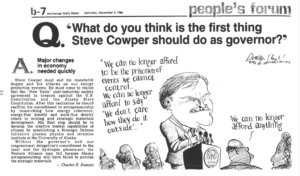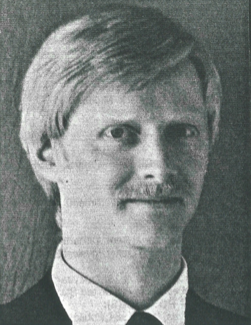
An Introductory Policy Statement by Charles E. Duncan Candidate for State House District 14, Seat A
I personally like you, but there are a few things that really bother me with your political economic thinking. I am not a professional politician or writer and sometimes I feel uncomfortable in public, but I do know the economic model that made the U.S. an agricultural industrial superpower. You talk about developing a rational long-term economic plan without identifying one specific industrial goal you would support. Since you seem to be the favored candidate maybe you can take my plan to Juneau (if you can beat me).
Alaska Is very much like a developing sector nation that has transformed from a pre-industrial composition of employment with masses of rural and urban poor to a post-industrial service society supported by oil revenues without even passing through an intermediate, industrialized phase.
This potential catastrophe has been cheerfully promoted in Alaska’s universities by the New York Council on Foreign Relations (CFR) through McGraw-Hill Publishing under a series called, “The 80’s Project”.
CFR and their British System of political economy argue that the engine of modern economy is consumer demand as expressed by the monetary purchasing power for consumer goods. Related to this popularized absurdity is the policy of encouraging large increases in assorted functions of administration, services, non-economic governmental expenses, and outright parasitic waste as a means for increasing the money quantity of consumer demand.
Large parts of the economies of Ibero-America have been ruined using this same model. These countries now have usuriously pyramided debt-service claims that are forcing their governments to extract real wealth from the broken backs of their labor force.
Alaska’s surplus wealth is now being steered away from development of capital goods industry, agriculture, and scientific-technological development enterprises, into fostering growth of consumer goods and “service” industries.
With a decline of revenues, the economic base of the Alaskan economy will lack the agricultural industrial development to produce sufficient per capita real income to enable the population to buy such levels of combined consumer goods and services outputs. This productive weakness cannot be overcome by simply promoting tourism. In effect, the per capita consumption requirements will end up exceeding the value of per capita output.
This will eventually lead to the draining of our savings to the point that the conditionalities doctrines (austerity) of supranational monetary and banking institutions will require a collapsing of our economy’s future ability to generate income and also pyramid further, at usurious rates, our per capita indebtedness. This scenario has happened so many times throughout history that it is becoming a never-ending battle.
So, what is the solution, Marco?
The first thing we must do is to develop a state industrial policy that will coincide directly with the national science driver project, the Strategic Defense Initiative (SDI), and produce materials for infrastructure and agriculture. This will ensure the maximum return with the least amount of effort expended while attracting federal and private funds.
At first it seems ironic that the solution to our industrial problem of economic development might come out of a military development program, but such a role for the armed forces and their engineering corps used to be a tradition in our nation.
Beam technology has been chosen by the U.S. executive branch because of its long-term strategic financial and civilian ramifications.
Real national security rests on economic growth, technological development, and human advancement that simultaneously provides a strong military and makes war unlikely.
A state team of plasma-arc and beam technology (relativistic physics) scientists and related robotics engineers should be set up to advise the selection and adaptation of minerals for export and capital goods production. This same scientific team can be used to combat environmental externalities (pollution) and establish points of entry in educational, laboratory, and production institutions through which the frontier technologies can radiate from within the economy.
As an example, capital goods such as galvanized corrugated and cellular sheet steel produced from the Red Dog Zinc Mine, using a plasma-arc furnace and robotics technologies, could be given investment tax credits, and used in construction of Alaska’s steel buildings. Effective, leveraged allocation of resources to these frontier industries will catalyze development and labor productivity far beyond the directly affected sector.
Precisely because technological advances, respecting their discovery and their successful employment, require and flow from development of the mental-creative powers of individuals, physical economy tends to stagnate wherever individual initiative is stultified by subordination to central authority. This is one of the reasons it is important to have representative government with an open-door policy.
Central direction of economy tends to succeed in respect to very large-scale physical undertakings of a sort in which private entrepreneurship is characteristically a poor performer as well as lacking the means to risk such undertakings generally. The proper general pattern of practice is to mix private funds with state-provided 2-4% loans in the development of frontier industries and to make the private investor’s management responsible for its own financial investment risk, and also that of the government in these joint public/private aspects of the complex.
Once the economy as a whole is channeled into an ever-growing technological spiral upward through promotion of frontier sectors, private business can then be counted on to make the thousands of day-to-day decisions that conform to the needs of both profit and state development. Industrial policy tends to work best for the economy through the shaping of the policy institutions of monetary and taxation policies and practices, including the dirigiste directing of low interest credit to high technology capital goods production. In general, it is necessary that accumulations of income in productive investment and closely related ventures be encouraged, and accumulation through financial speculation, ground-rent price speculation, and commodity price fluctuations speculation be taxed at a higher rate.
Those people who say that any state industrial policy is undemocratic or unethical are either simply misinformed about physical economic principles or have been brainwashed into believing in the anti-Christian oligarchical model of society.
If you don’t know the difference between temporary paper profits and real production then study the American System of political economy as defined by Gottfried Leibniz, Benjamin Franklin, Henry C. Carey, Alexander Hamilton, and the German republican protege of Marquis de Lafayette, Friedrich List (Please call me for an economics book). For those people in the second category, I suggest taking a walk to your nearest Christian church.
Don’t you people understand that without the civilian mobilization of the U.S. economy spilling over from the SDI that the international strategic financial crisis we are facing will cause heavy taxation and force us to accept Henry A Kissinger’s “New Yalta” agreement (see March 1984 issue of Time magazine) where the U.S. will continue to decouple from Western Europe economically and militarily.
We must view our industrial policy not just for its prime ability to generate revenues, but in context of the Grand Strategy of our Republic to provide the material preconditions for developing the God-given creative potentials of mankind. It is killing me because Alaska is not participating in a community of agricultural and industrial principles, but instead is acting like a pre-adolescent child and consequently is going to be severely taken advantage of by continuing post-industrial policies.
This is why I am running for office and asking the question, where is your rational long-term economic plan, Marco?