Green Bank or Alaska State Bank?
I began publishing the United Alaska Campaigner economics newsletter in 1984 and have seen many years of political life in Alaska since that time. Today, I continue with my Alaska Emergency Employment Mobilization series on the alaskastatebank.net website and Alaska State Bank Advocate Facebook page.
The focus of my writing has always been financial reform and economic development using modern infrastructure and advanced technology in cooperation with the United States federal government.
I remember the tragic failure of the Alaska Science and Technology Foundation and the Alaska Science and Engineering Commission that is now a case study on how not to develop Alaska’s economy. Many lessons were learned by these failures, yet our state is preparing to repeat the same errors.
As the primary author of the Alaska State Bank legislation that is designed to promote advanced technology and access federal and Federal Reserve monetary policy funds, I can clearly see the errors of the proposal to create the Energy Independence Fund (i.e., Green Bank).
As was the case with the Alaska Science and Technology Foundation, the Green Bank (not lawfully a bank only a fund) has many problems including not having a clearly defined criteria for determining investment into technological advancement based on known principles of industrial science.
This basic lack of science and engineering criteria is substituted by the nebulous to “reduce greenhouse gas emissions” or “sustainable energy development” as the Green Bank’s primary measurements for determining success—and as such will predetermine the eventual failure of the institution as a driver of economic development.
In fact, many of the promoters of the Green Bank proposal prefer to not have economic development as a measure as evidenced by their continuing attempts to extract the Green Bank proposal from the Alaska Industrial Development and Export Authority’s (AIDEA) management.
What some of the promoters of the Green Bank fear is that under the direction of AIDEA the Green Bank may have competent economic development administration even if the original mandate of the Green Bank is inherently anti-development through the denial of proven principles of industrial science—such as energy flux density as an industrial physical principle and the multiple mathematical formulas that derive from that principle.
Promoting and developing technologies that are already known to be inefficient and or obsolete through understanding proven engineering principles is not the path to a more prosperous future for Alaska.
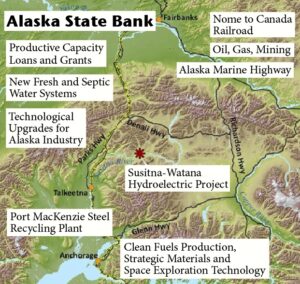
Even worse, the Green Bank proposal intentionally negates investments into the technological upgrades for our oil, gas, and mining industries that are necessary for future competitiveness. The Alaska State Bank proposal fully supports Alaska’s current industries and promotes the addition of advanced industrial technologies into existing and new productive capacity.
Creating the Energy Independence Fund that is not legally a bank and therefore cannot have direct access to federal and Federal Reserve monetary policy is a waste of time and effort when our priority must be to immediately access those funds using methods that promote modern infrastructure and qualitatively transform existing technology.
Let us study the criteria of technological advancement as defined in the Alaska State Bank legislation and reject the Green Bank proposal.
Even though a few worthwhile parts of the Green Bank legislation can be incorporated into the Alaska State Bank there should be a no vote on the Energy Independence Fund proposal—so our state does not make the same mistakes over again.
The following incomplete alphabetically ordered list of physical and engineering principles and technological measuring terms must be understood to prioritize modern technological investment: amperage, automation, brightness, British thermal units, capital intensity, clarity, clustering, compaction, complexity, compression, conductivity, durability, dynamics, electrification, energy coherence, energy conversion, energy efficiency, energy flux density, energy intensity, frequency, horsepower, intelligence, intensity, joules, luminosity, machine tool principle, machining, miniaturizing, modularizing, newtons, performance, plasma coherence, potential population density, principle of least action, productivity, progression, prototyping, qualitative transformation, radiancy, readiness, reliability, renewability, resilience, safety, scaling, science driver, self-organization, speed, sustainability, standardizing, symmetry, synchronizing, thermal efficiency, throughput, torque, transparency, velocity, viscosity, volumetric energy density, volumetric energy efficiency, validating, voltage, wattage, and work flux density.