Wednesday, February 28, 1990
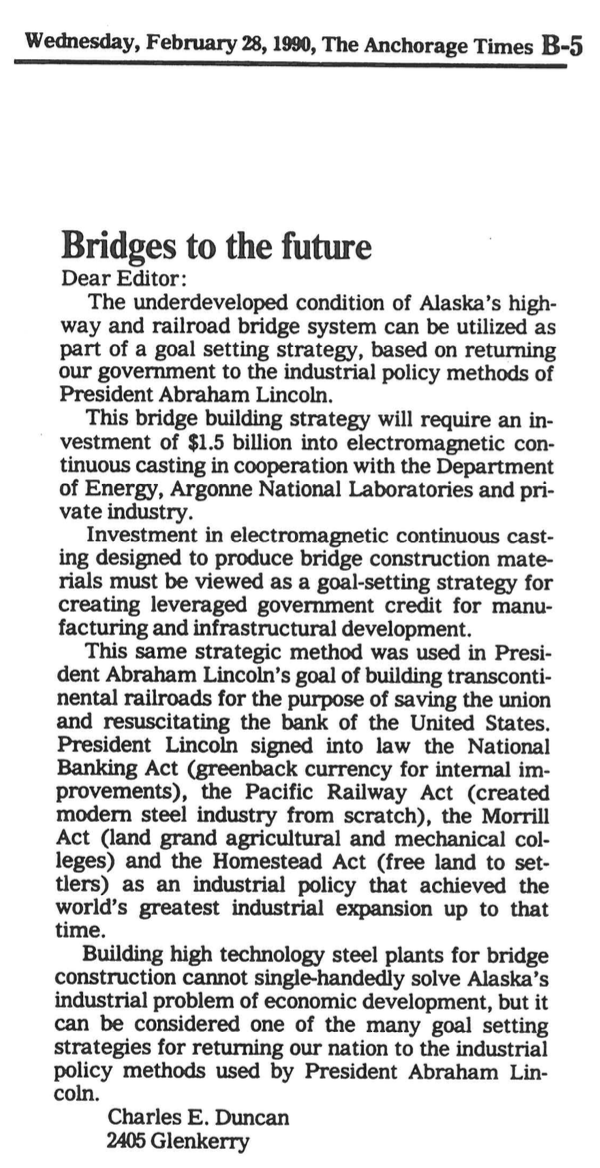
Bridges to the future.
The underdeveloped condition of Alaska’s highway and railroad bridge system can be utilized as part of a goal setting strategy, based on returning our government to the industrial policy methods of President Abraham Lincoln. This bridge building strategy will require an investment of $1.5 billion into electromagnetic continuous casting in cooperation with the Department of Energy, Argonne National Laboratories, and private industry.
Investment in electromagnetic continuous casting designed to produce bridge construction materials must be viewed as a goal-setting strategy for creating leveraged government credit for manufacturing and infrastructural development.
This same strategic method was used in President Abraham Lincoln’s goal of building transcontinental railroads for the purpose of saving the union and resuscitating the bank of the United States. President Lincoln signed into law the National Banking Act (greenback currency for internal improvements), the Pacific Railway Act (created modern steel industry from scratch), the Morrill Act (land grand agricultural and mechanical colleges) and the Homestead Act (free land to settlers) as an industrial policy that achieved the world’s greatest industrial expansion up to that time.
Building high technology steel plants for bridge construction cannot single-handedly solve Alaska’s industrial problem of economic development, but it can be considered one of the many goal setting strategies for returning our nation to the industrial policy methods used by President Abraham Lincoln.
Charles E. Duncan