House District 14a BY LARRY MAKINSON Daily News reporter, August 1984
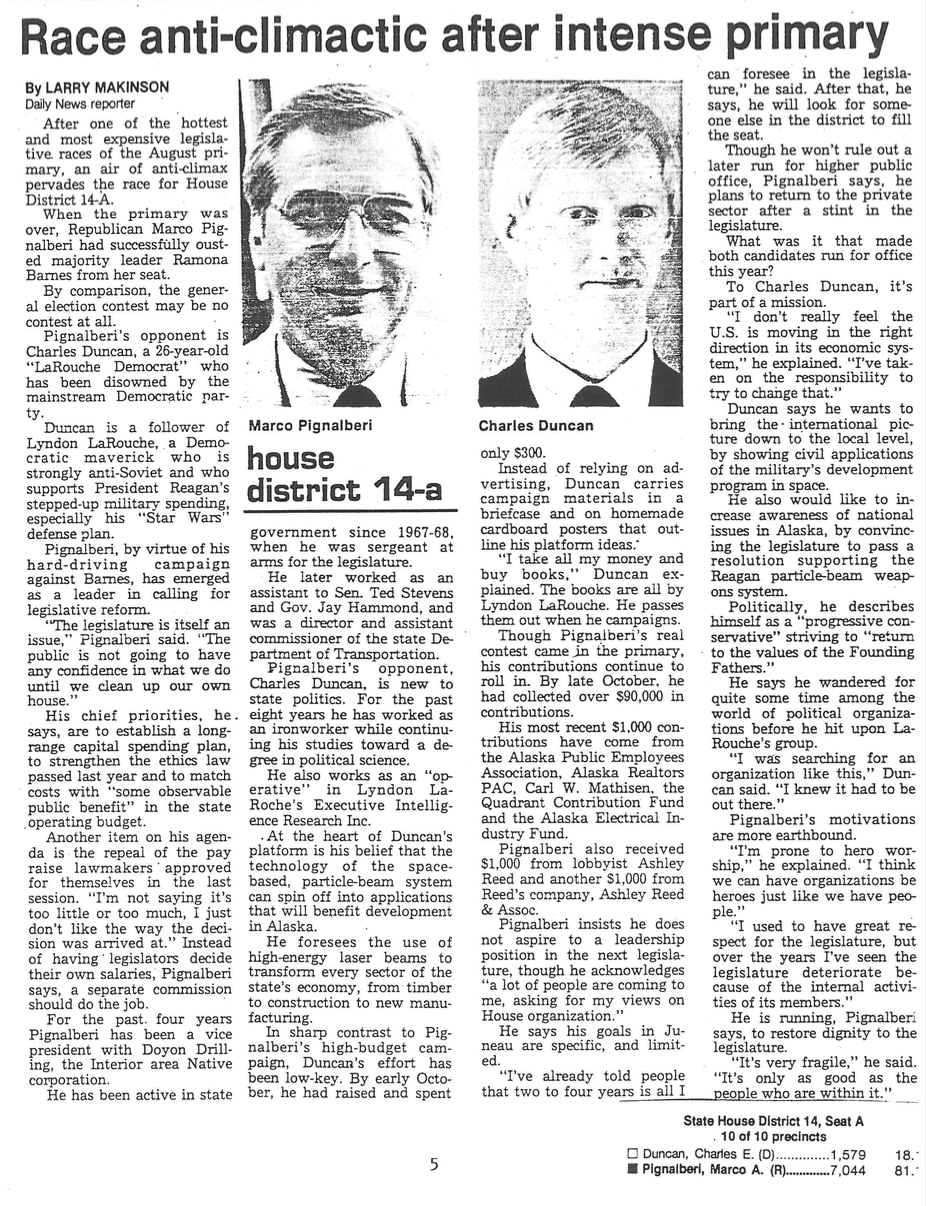
After one of the hottest and most expensive legislative races of the August primary, an air of anti-climax pervades the race for House District 14-A.
When the primary was over, Republican Marco Pignalberi had successfully ousted majority leader Ramona Barnes from her seat. By comparison, the general election contest may be no contest at all.
Pignalberi’s opponent is Charles Duncan, a 26-year-old “LaRouche Democrat” who has been disowned by the mainstream Democratic party. Duncan is a follower of Lyndon LaRouche, a Democratic maverick who is strongly anti-Soviet and who supports President Reagans’ stepped-up military spending, especially his “Star Wars” defense plan.
Pignalberi, by virtue of his hard-driving campaign against Barnes, has emerged as a leader in calling for legislative reform. “The legislature is itself an issue.” Pignalberi said. “The public is not going to have any confidence in what we do until we clean up our own house.” His chief priorities, he says, are to establish a long-range capital spending plan, to strengthen the ethics law passed last year and to match costs with “some observable public benefit” in the state operating budget.
Another item on his agenda is the repeal of the pay raise lawmakers approved for themselves in the last session. “I’m not saying it’s too little or too much, I just don’t like the way the decision was arrived at.” Instead of having legislators decide their own salaries, Pignalberi says, a separate commission should do the job.
For the past. four years Pignalberi has been a vice president with Doyon Drilling, the Interior area Native corporation. He has been active in state government since 1967-68, when he was sergeant at arms for the legislature. He later worked as an assistant to Sen. Ted Stevens and Governor Jay Hammond and was a director and assistant commissioner of the state Department of Transportation.
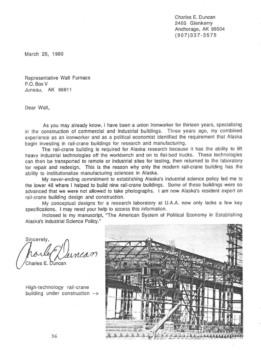
Pignalberi’s opponent, Charles Duncan, is new to state politics. For the past eight years he has worked as an ironworker while continuing his studies toward a degree in political science. He also works as an “operative” in Lyndon LaRoche’s Executive Intelligence Research Inc.
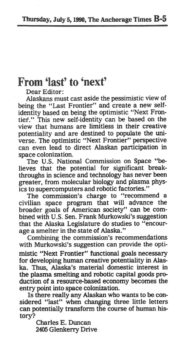
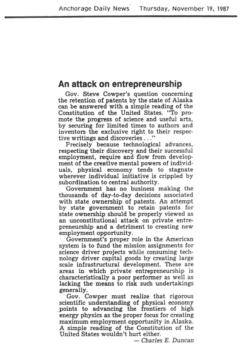
At the heart of Duncan’s platform is his belief that the technology of the space-based, particle-beam system can spin off into applications that will benefit development in Alaska. He foresees the use of high-energy laser beams to transform every sector of the state’s economy, from timber to construction to new manufacturing.
In sharp contrast to Pignalberi’s high-budget campaign, Duncan’s effort has been low key. By early October, he had raised and spent only $300. Instead of relying on advertising, Duncan carries campaign materials in a briefcase and on homemade cardboard posters that outline his platform ideas.
“I take all my money and buy books,” Duncan explained. The books are all by Lyndon LaRouche. He passes them out when he campaigns.
Though Pignalberi’s real contest came in the primary, his contributions continue to roll in. By late October, he had collected over $90,000 in contributions. His most recent $1.000 contributions have come from the Alaska Public Employees Association, Alaska Realtors PAC, Carl W. Mathisen, the Quadrant Contribution Fund and the Alaska Electrical Industry Fund.
Pignalberi also received $1,000 from lobbyist Ashley Reed and another $1.000 from Reed’s company, Ashley Reed & Assoc. Pignalberi insists he does not aspire to a leadership position in the next legislature, though he acknowledges “a lot of people are coming to me, asking for my views on House organization.
He says his goals in Juneau are specific, and limited. “I’ve already told people that two to four years is all I can foresee in the legislature,” he said. After that, he says, he will look for someone else in the district to fill the seat.
Though he won’t rule out a later run for higher public office, Pignalberi says, he plans to return to the private sector after a stint in the legislature.
What was it that made both candidates run for office this year?
To Charles Duncan, it’s part of a mission “I don’t really feel the U.S. is moving in the right direction in its economic system,” he explained. “I’ve taken on the responsibility to
try to change that.” Duncan says he wants to bring the international picture down to the local level, by showing civil applications of the military’s development program in space.
He also would like to increase awareness of national issues in Alaska, by convincing the legislature to pass a resolution supporting the Reagan particle- beam weapons system.
Politically, he describes himself as a “progressive conservative” striving to “return to the values of the Founding Fathers.”
He says he wandered for quite some time among the world of political organizations before he hit upon LaRouche’s group. “I was searching for an organization like this.” Duncan said. “I knew it had to be out there.”
Pignalberi’s motivations are more earthbound. “I’m prone to hero worship,” he explained. “I think we can have organizations be heroes just like we have people.” “I used to have great respect for the legislature, but over the years I’ve seen the legislature deteriorate because of the internal activities of its members.”
He is running, Pignalberi says, to restore dignity to the legislature. “It’s very fragile,” he said. “It’s only as good as the people who are within it.”